
Rhyming Words for Kids: Lists, Examples, and Activities That Actually Work
- Admin

- Jun 30
- 6 min read
Somewhere between the second repetition of Rain, rain, go away and the third demand for a plate of pakoras, most Noida parents have accidentally taught their child something important - that away and day sound the same and also that words can be playful long before they become particularly meaningful.
That is rhyming. And children begin noticing it much earlier than we often assume.
At Mini Mavericks, we see this happen regularly. A teacher pauses halfway through a poem, and a three-year-old fills in the missing word with complete confidence, looking mildly offended that the adults were taking so long. Those are the moments that matter - they tell us that language is quietly settling into place as intended.
For many parents, rhyming feels like one of those charming but optional childhood things. It is that sweet nursery-rhyme territory, nice to have but not particularly important. In reality, rhyming does far more work than it gets credit for.
What Are Rhyming Words?
Rhyming words share the same ending sound, even when their spelling looks different. For example:
Cat and hat
Moon and spoon
Play and day rhyme
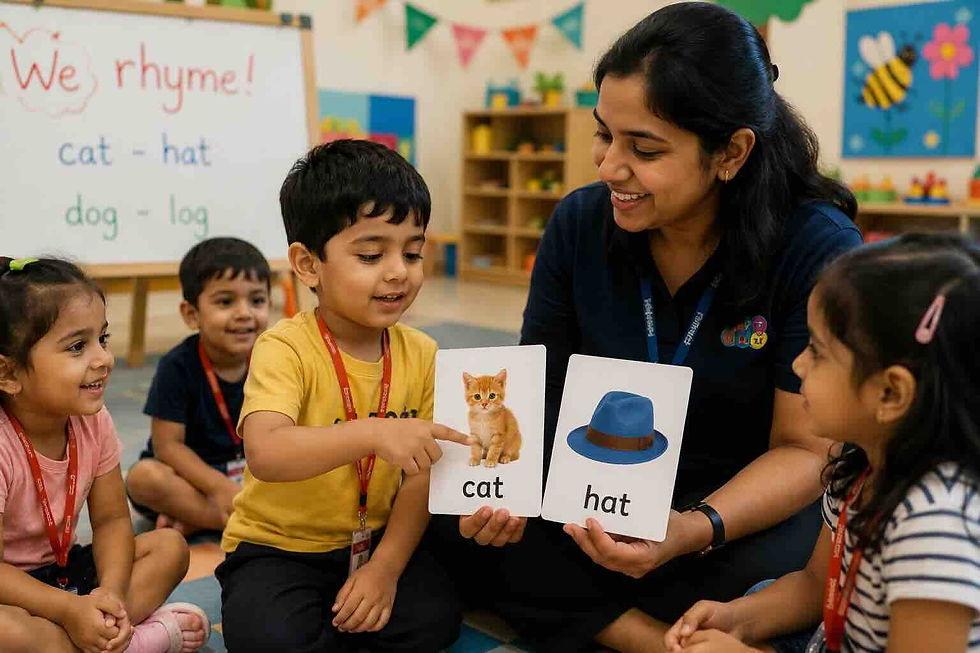
Children do not need formal definitions to understand this. They simply need repeated exposure.
A child hears a favourite rhyme enough times and begins anticipating what comes next.
At first, they repeat, then they predict and eventually, they invent their own. This progression is something critical for their cognitive development and language learning.
Language comprehension in the early years rarely arrives through instruction alone. Later, it grows through repetition, familiarity, rhythm and play. The same way a child learns the tune of a song before understanding every word, they begin noticing rhyming patterns before anyone formally explains them.
Rhyming Is Not Just Fun. It Is Foundational.
A landmark study by MacLean, Bryant and Bradley (1987) found that children's knowledge of nursery rhymes at age three was one of the strongest predictors of their reading ability two years later - stronger than IQ or social background.
Here’s is why it is a game changer for kids in pre schooling age:
It Builds Early Language Awareness
When a child notices that sun and fun sound alike, they begin understanding that words have pieces: beginnings and endings that can shift and change.
That small realisation forms the foundation of phonological awareness, a skill strongly connected to later reading ability. A child who notices patterns in sounds usually finds it easier to recognise patterns in words later.
Vocabulary Expands Without Memorisation
A child who knows the word book quickly starts picking up look, cook, and hook. No flashcards or books required.
Frankly, many vocabulary worksheets introduced at age three are solving a problem that does not really exist. Children learn language remarkably well through repeated exposure, especially when rhythm and sound are involved. Rhyming does the same job more gently and with considerably less resistance (and fewer arguments)!
Memory Improves
Children remember patterns better than isolated information. This is why a four-year-old can recite an entire nursery rhyme after hearing it three times but forget where they left their water bottle ten minutes ago.
The connection between early sound play and later literacy is well established by research. It is also one of the least stressful things parents can do something about.
Listening Skills Improve
To notice a rhyme, a child has to actually pay attention to the sounds inside words, not just let them pass by.
That habit transfers elsewhere also: following instructions, paying attention during stories, understanding conversations in a busy classroom. Listening is one of those invisible skills that quietly shapes everything else.
Speaking Confidence Grows
There is a particular expression children make when they correctly predict a rhyming word before an adult says it. Pride, delight, and mild superiority all at once. That feeling matters. Confidence in language often begins in tiny moments where children feel genuinely capable.
Three-year-olds deserve more opportunities to feel clever.
Rhyming Words for Nursery Children (Ages 2 to 3)
At this stage, short and familiar words work best. The closer the words are to a child's everyday world, the more likely they are to stick.
Word | Rhymes With |
Cat | Hat, Bat, Mat, Rat |
Sun | Fun, Run, Bun |
Dog | Log, Fog |
Mug | Bug, Jug, Hug |
Pen | Hen, Ten |
Cup | Pup, Up |
Bed | Red, Fed |
Point to real objects whenever possible. The child who has held a mug while hearing the word will remember it differently from one who only heard it floating through the air. Early learning is more physical than adults often realise.
Sometimes children become unexpectedly attached to one rhyme and insist on repeating it endlessly. That is usually a good sign. Even if hearing cat-hat-bat fifty times in one afternoon begins testing your patience.

Rhyming Words for Preschool Children (Ages 3 to 4)
Preschool children are ready for a little more complexity. At this age, they enjoy guessing games, finishing sentences, and spotting patterns independently.
Word | Rhymes With |
Ball | Tall, Fall, Wall, Call |
Tree | Bee, See, Free, Me |
Cake | Make, Take, Lake, Wake |
Book | Look, Cook, Hook |
Rain | Train, Plain, Brain |
Car | Star, Far, Bar |
Night | Light, Bright, Tight |
Research consistently links early rhyming exposure to stronger reading readiness. The connection is well established. Children often understand concepts before they can explain them properly. That gap is completely normal.
Rhyming Words in Sentences
Rhyming Pair | Example Sentence |
Cat / Mat | The fat cat sat on the mat. |
Sun / Fun | We had so much fun in the sun. |
Tree / Bee | A little bee sat under the tree. |
Rain / Train | The red train came in the rain. |
Book / Look | Take a look at this wonderful book. |
Moon / Spoon | The spoon shone under the moon. |
Ball / Wall | He kicked the ball into the wall. |
Night / Bright | The stars were bright all through the night. |
Play / Day | We play outside every single day. |
Cake / Lake | She ate her cake beside the lake. |
Try reading these aloud and pausing before the final rhyming word. Children usually enjoy filling in the blank. When they get it right, make a proper fuss about it. Small celebrations go surprisingly far.
Three Activities Worth Trying at Home
No worksheets required. You mostly need five minutes and a willingness to be mildly ridiculous.
The Rhyme Chain Game: Start with a word. You say cat. Your child says hat. You say bat. Keep going until someone runs out. The loser does a silly dance. The game usually collapses into chaos around the seventh rhyme. Possibly ideal.
Rhyming Treasure Hunt: Hide objects around the house and give clues in rhyming form. "Find something that rhymes with red and goes on your head." "Find something that rhymes with book and helps you cook." Children become unexpectedly competitive about this. You may find yourself firmly corrected.
Finish My Rhyme: During breakfast or on the way to school, begin a sentence and leave it unfinished. "The little dog sat on a..." Let your child fill it in. If they invent a nonsense word, even better. Made-up rhymes usually mean the concept has properly landed. Do not rush to correct them.
A Note for Children Growing Up Bilingual in Noida
Children in Noida often move between Hindi and English many times a day, sometimes without noticing. Parents occasionally worry that this might slow language development. It usually does the opposite.
A child who already notices that raat and baat sound connected in Hindi often develops an ear for sound patterns in English more quickly too. Researchers call this phonological awareness. Children simply experience it as language becoming familiar.
At Mini Mavericks, we work with bilingualism rather than around it. Rhyming games happen across languages, and children regularly make connections we did not predict. Some of the best classroom moments happen entirely by accident.
Frequently Asked Questions
At what age do children begin noticing rhymes?
Usually between two and three years, though babies often respond to rhythm much earlier than that.
Will English rhymes confuse a child who speaks Hindi at home?
Not usually. Children who hear more than one language often become better at noticing sound patterns overall.
How much practice is enough?
A few minutes most days genuinely works. Rhyming in the car counts. Rhyming during breakfast counts. It does not need structure.
What if my child invents nonsense words? Well that’s usually, a good sign. It means they are experimenting with sound patterns on their own.
And, One Last Thing!
Most children do not learn rhyming because somebody formally teaches it. They learn it while waiting for lunch, listening to songs, sitting in traffic, and repeating the same poem until every adult in the house knows it by heart.
Start with cat and hat. The rest to your delight shall just follow!
(Mini Mavericks is a preschool in Noida where early learning grows through stories, music, movement, and a great deal of joyful noise. If you are exploring a preschool in Noida where curiosity matters as much as confidence, we would love to meet you.)


Comments